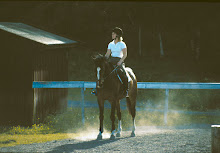
It dates back to the 17th century.
My daughter is on her way into the stable to get hers.
A neverending journey to become a better rider
Hope you are enjoying your summer all, and that you have better weather than we have here at the moment!
It is by the Norwegian author Per Petterson, and is called "Out stealing horses"
I am sorry folks, it is not about horses.
In the summer of 1948 Trond and his father is living up in the forests close to the Swedish border. Trond is 15, and what he experiences in those weeks will change his life.
More than 50 years later he is moving to a small cottage in the middle of nowhere with his dog, and something happens that brings the memories from 1948 back.
This is a lowkeyed book about a mature man, reflecting back on his youth from a self-inflicted isolation - which perhaps brings the memories even more vividly back for him.
In the summer time I like to read crime novels.
Here are two of my favourite Swedish authors: Camilla Läckberg and Liza Marklund.
They both have female leading characters.
Camilla Läckberg first.
Her first novel is called The ice princess and is taking place in the small town of Fjällbacka where the writer Erica Falck is returning after the funeral of her parents. She finds her childhood friend, Alex, with her wrists slashed, and her body frozen in an ice-cold bath. Has she has taken her own life, or is there something more behind the tragedy?
Camilla Läckberg was voted Swedish Writer of the Year for 2005, and her books have also been filmed as television series.
Next one out is Liza Marklund.
Her first book in the series of the reporter Annika Bengtzon is called The Bomber.
A bomb explodes in the recently constructed Olympic village in Stockholm just months before the Summer Games are set to begin.
Annika Bengtzon is a crime editor for the Stockholm tabloid Kvallspressen and is set to cover the incident. She is not convinced that it is a terror act, and as she digs deeper she uncovers some secrets which get her into trouble (of course!).
Then over to Stieg Larsson's Millenium Trilogy, where The girl with the dragon tattoo is the first book.
These books have become very popular not only in Scandinavia but also abroad, and are now also filmed.
The main characters are a bit out of the ordinary; a disgraced financial journalist and a socially outcast female superhacker.
It is a quick paced novel, hard to put down.
It is always a risk to get disappointed when something becomes very popular, and I have to admit that maybe my expectations were a bit too high. I liked the novel, but didn't find it extraordinary.
And from crime novels over to a book that made me laugh. Often.
The last item is not a book, but a movie - and one of the better I have seen for quite a while.
Stillearning wrote:
HOC, when you have time, could you also write a description of riding a horse straight, as in keeping equal weight in each rein, etc.?....I'm currently riding a "wiggle worm", so would enjoy your input.
So here comes a try.
First, I hope that she means the same as I do when it comes to a "wiggly" horse.
To me, it is a horse that pops out here and there.
Like when you are riding on a circle, the shoulder falls out. So you correct it, just to find that the horse then places the hindquarters to the inside instead. So you correct that etc, etc.
I think this problem, as well as the solution, differs a bit from the crooked horse (link to earlier post). So again I hope I have understood your question correct, stillearning?
First, I must say that my input here is just some personal comments from how I would have tried and solved the problem if I experienced it myself. I am not a professional trainer, and I do not know your horse or you as a rider, stillearning, so take it for what it's worth, ok?
And I am (as always) happy to get input/comments/questions from others!
Anyway, here are my 2 cents:
A wiggly horse is not easy to ride.
It is an evasive pattern in the horse, and I believe we'll have to go back to basics, as much of the problems we experience when riding is solved by looking at the base requests on the horse.
Many riders have heard of Steinbrecht's dictum
"Ride your horse forward and make him straight",
and I believe here lays the answer to this problem.
I would start by checking that my horse was really thinking forward.
I would make sure that he kept a clear rhythm and was in balance, but I would otherwise not worry too much about frame or collection. Sometimes this problem creeps up if the rider worries too much about frame and forgets that the horse always has to be in front of the leg.
So what to do?
I would want my horse to think forward as soon as I soften my hand, with the slightest touch of the leg. If he doesn't, I have to correct.
I would praise a lot when I get a reaction, and if I get more forward than I asked for, I would avoid putting on the brakes immediately as it will confuse my horse.
I would try and keep my horse relaxed, but attentive.
Exercises: Work much with transitions within the gait.
First, find a good working rhythm, and get your horse to relax and with a soft contact on the bit. Then, while keeping the rhythm try and soften your hands and get the horse to lengthen some strides. Don't ask too much in the beginning. Make sure he doesn't tense up and increase speed and rythm. Posting trot makes it easier, and helps you and the horse to think about the rythm. Help him with a tap on the hind quarters from a dressage whip if he doesn't understand. Praise immediately when your horse offers the right response.
Then through half halts, softly collect again for a few steps. When you collect, it might again be necessary to tap on the hindquarters to help your horse to understand that he needs to activate the hind legs, and not solve the equation by working with less energy.
Repeat.
And repeat.
For each time, find the working trot/canter in between and make your horse relax before you again start to ask for lengthening/shortening of the strides.
What you should be looking for is that the horse actively seeks contact on the rein.
Make sure that you have a true three-beat rythm in the canter, also when you collect. If you get a four-beat it is due to lack of impulsion - get some more energy into the work!
Keep the balance in corners and in changes of direction through half halts. Make sure that your tempo here is not larger than the horse can handle. If you feel loss of balance, collect more or make a transition downwards.
Then start to work with transitions between the gaits.
Concentrate on quality.
In the transistions upwards, remember that the movement has to start with engaged hindlegs, and not by pulling with the front end.
Concentrate on how it feels.
Does your horse respond quickly? Is he using the front or the rear engine most when getting started? Does your horse get heavy in the hand? Is he tensed or relaxed? Again, use a dressage whip if necessary to tap the hindquarters to help the horse understand what you want.
Downhill transitions:
Prepare, prepare is the key. Collect the horse first through half halts. Try and use the seat, and as little hand as possible. If you feel that the horse falls on the forehand and get heavy in the hands - correct it by not doing the transistion but to ride on again - like you have been doing when riding transitions within the gaits earlier. Ride the horse forward to get the hind legs working again. Then make a new attempt.
Try and keep the horse relaxed all through the work.
If he tenses up in the poll or jaw, he will not work correctly. I would then introduce some circles and flex to the inside, with an immediate release on the inside rein when he gives. I would make sure that when I ride my circles I have a soft, but steady contact in my outer rein. If I lose that contact, I would add more inside leg, to engage the inside hind and achieve bend in the body.
In the base of the German training scales lies
1. Rhythm
2. Relaxation and
3. Contact
All these three are important when we work with the wiggly horse.
We have to send the horse forward, to get a true contact - but while maintaining the rhythm and keeping the horse relaxed.
Remember that the hand has to be quiet, as the engagement comes from the hindlegs into the hand to create a correct contact.
The rider's seat also plays an important role here. To keep a quiet hand the rider needs an "independent seat", i.e. he should not be depending on rein contact to keep a good balance.
Did that help, stillearning?