Showing posts with label dressage. Show all posts

March 22, 2010

Clinic with Kyra - Back to basics!


A couple of weeks ago I was at a clinic with Kyra Kyrklund.
I know some of you have been waiting to get some information about this, so here are my notes.
(With emphasis on NOTES.)
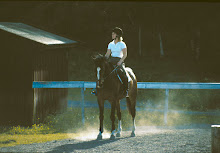
Lousy pictures, I know - but better than nothing?
And as always, it's back to basics.

A short introduction of Kyra from her home page:

Few riders in the world have managed to train and successfully compete so many different horses in international Grand Prix dressage.

Kyra is a fundamentalist and believes strongly that the quality of the paces reflect the basic training. Every horse that comes for training is evaluated along the same lines - is it forward, is it straight and is it submissive in a relaxed way.
Every pace, every movement depends on the quality of the foregoing exercises.
The riders, even international Grand Prix riders, are evaluated for their effect on the horse and their correct way of sitting and influencing the horse.


"How can you describe the taste of strawberry jam to someone who has never tasted it?"
That is how Kyra describes the difficulty of communicating the feel you need when riding.
She stated in her introduction that she often let her pupils ride one of her own horses, to "taste the jam", or she herself mounts her pupil's horse to let her pupil sit up afterwards and get a taste of the right feel.

The trainer has to assess his pupil, and start to work on one of the things that needs improvement. If it doesn't work, leave it be for a while and work on something else instead. She said that often when a trainer gets frustrated it is because they don't change the approach on how to work with things:
"You need different tools to change things. Do not be frustrated if things doesn't work out , just try to use a different tool instead. Riding is matter of balance and coordination both from the rider and the horse."
She also stated that her best pupils were the adventurous ones - the ones ready to try new things out.


Two lovely pony riders enters the arena.
Kyra watches them for a while, and then starts to work with them.

One rider is sway in the back, and that makes her seat weak. The horse pulls his rider slightly forward, out of center.
The rider has not total control - who leads who?
"Sometimes the horse takes over, and then the rider loses her balance. When the horse puts weight in the reins the rider is easily placed forwards."
Kyra states that the rider is not to be strong, just to be steady and counteract until the horse relaxes.
"The rider needs to sit in center - like on a balancing pole.
If the rider is not placed steadily in center, the horse's hind legs might work behind him instead of under."


How should the rider to be able to sit steady and to counteract the pull from the horse?
Not by pulling back on the reins, but by using the body:
Keep the elbows at your sides.
Have someone standing on the ground beside you, and to keep a flat hand against your elbow. Press the elbow against the hand, and feel what happens in the abdomen. You should feel stronger in the body instead of being stiff and hard in the hand.
Your body should be like a frame in where the horse should work - the more educated and fitter the horse, the tighter the frame.
"If the horse gets strong in one rein, imagine your helper at your elbow and use your body to keep the frame. As soon as the horse gives, relax yourself.
Sit deep, but imagine it's the earth gravity that draws you there, not active muscle power."

Balance your weight on the triangle of the seatbones and the pubic bone.
Hip joint absorbes the movement.
Feel the horse in your elbows.
The more speed the more difficult the exercise will be. If you cannot do something slow, you won't be able to do it fast.

"When riding forwards, you can either choose to change rythm, or change stride length."
The rider has to decide what she wants.
To be able to do passage, you have to be able to ride the small and quick steps.
The more control you have of the horse's strides, the better control you have over the horse's body and mind.
"Somewhere you'll find the ideal working rhythm for each horse, but you have to be able to ride variations."
Check your position.
Ride slow, check the rhythm.
Change to a quicker rhythm, but the horse should not run faster. Check that you are not getting strong in your hands.
Transistion to longer steps, but keep the same rhythm this time.
Do not let the horse get long and strong! Keep the horse supple, keep your position. Short steps again, without shortening the neck! Some more leg, keep the contact and rhythm and engage the horse and see if you can get him up in the neck. The horse is not allowed to run faster!

One of the riders had trouble with her pony that weighted his left shoulder, and avoided contact on right rein.
She tried to solve the problem by flexing the horse to the left, something that Kyra explained would not help the problem. "The problem is not in the mouth but in the body."
Kyra wanted her to imagine a ring around the neck:
"Imagine that you are to slow the horse down with the neck ring, keep the ring still but sit against the horse - and let the horse carry himself."
When asked, the rider admitted that she had 90 % of her concentration on the horse's head, and 10% on his body.
Kyra: "You must ride his entire body, not only concentrate on his head or mouth. When he gets strong, imagine that you slow him down with the neck ring."
"As soon as your horse is doing something you are changing your goal as you concentrate on your horse's head. Remember that your horse works in a correct outline only when he's working correct in his body."
Concentrate on equal weight in the ring.
The difficult side is the side avoiding contact!
Left rein means go left, right rein means go right, ride the body instead!
Do not shorten your left rein, use your legs instead!
Concentrate on the ring!
Your horse tries to run away from the problem, but in a tug contest you need two participants.
If he tries to weigh down his left shoulder or if your horse tries to run away, slow down with both hands.
Check that you have equal weight in both hands!

The two pony riders had their ponies working very nicely in the end, and were exchanged with two horses where the riders were using double bridles.


One of them had a problem as the horse was going too deep.
"If your horse gets too deep, a common fault is that the rider raises her hands.
The curb lowers the horse's head, and the bradoon raises it - so when the horse lowers his head the curb automatically influences more.
You must learn to know the difference between the curb and the bradoon when riding, and how they influence the horse.
You cannot lift the horse through the bit, you must ride them up."
Kyra then asked them to change the way they held the reins; the curb rein going in on lower part of the hand and the bradoon on top of the hand to make it easier to separate the effect of the two bits.


She then asked them to imagine that the horse's body was like a ball.
The riders body must act like dribbling/bouncing the ball, where the rider's body increases or decreases motion.
Small, fast dribbles or long high ones.
"You need to pump air into the horse with your legs. You cannot pump it by squeezing.
Somewhere the ball has its highest point, and somewhere its lowest. You can sit behind the movement, or in front of it. You can also sit off center left or right - and your horse will act accordingly! Your anus ring should be in center"
(sorry guys, a bit blunt but I am just quoting here, lol!)
If you tense up in your bum, you will not sit deep into the saddle.
Keep your neck ring centered, and use your lower leg to pump up the ball, and increase the amount of energy.
Imagine that the neck ring will move faster, because the desired activity is in the horse's back - not in his legs.
Imagine that you have a spring between your knees, they also have to play with creating energy into the ball.
If the horse takes control and speeds up, make a transition to walk.
The horse has to take full responsibility for his self-carriage.
The horse has to carry the rider, not the other way around!
If your horse wants to run away, imagine that you have to keep his front legs under you.

If you cannot change your horse's way of moving in trot at a circle - long strides and short strides as well as his form; long neck and high neck - how are you to handle the more advanced movements?


----
Far too soon the clinic ended.

Dear Santa.
Next year I would like to have a training session with Kyra, please?
You can add it to my list together with the indoor arena, the two GP-horses and the money to go with it.
I'll be good.
(At least MOST of the time.)
Kind regards,
"Hopeful"

February 23, 2010

Thwarted plans


I should never have cleared that terrace from snow.

During the week the temperature started to drop again, and we were down to the -20C/-4F again.
Then the snow came.

At Thursday evening, when I was to have my first training for Jimmi, it was windy and snowing.
Jimmi arrived late from Denmark, so I did not have my training until 10.20 pm.
As the stable closes at 11 pm, we just had to have the session at home in the outside arena. Jimmi was stoically shouting in the wind, slowly covering up in snow.
I was frantically trying to hear what he said.
My hearing has not improved over the years. Hahem.
Still he was happy with the progress from last time, which was nice to hear.

I was to have two more trainings, on Saturday and Sunday.
I had even booked my daughter as a photographer, so I would be able to illustrate this blog post with some pictures.
It is not easy to photograph oneself when training, and as there have been many photos of surroundings on trail with parts of a horse head, or some ears in the foreground, I guess a change would be welcome.
I was really looking forward to the training.


But I had not calculated with the weather.

During Friday both the wind and the snowing increased.
When I woke up on Saturday morning, it was as close to a snow storm as you will get in the lowlands here. Nothing like in the mountains, but strong wind and heavy snowfall.
And in addition -12C/10F.

I called Jimmi as I had a hunch that he would prefer to have the training indoors that day.
Funny enough, he thought that would be a good idea.
(And that is how you cannot see any photos of Fame and me doing upper level dressage. It would, of course, otherwise be filled with piaffes and canter pirouettes left and right.)

I wrapped myself and Fame up in layers, and started the ride of half an hour to the indoor arena.
The wind and the snow were beating against my face, and I drew the scarf even tighter up towards my eyes, bending my head against the snow so the rim of the helmet took off for most of it.
Fame heroically trudged on through the snow and the wind.
When we reached the forest, it took off for some of the wind and it was a bit easier to see where we were going.

I had calculated a bit extra time to get all the layers off once we got to the indoor arena, and to get Fame accustomed to the arena again.
When we got inside and reached her spooky corner at the short side (where I cunningly had planned to undress), the wind and the snow were beating against the wall that was partly covered with some plastic, creating an eerie sound.
My horse immediately turned into an antelope again.
All her suspicions were confirmed.
That corner had bogey men inside the walls.
*sigh*

I started to warm up, and even if Fame relaxed better on the circle around Jimmi at the other side of the arena, she was still somewhat tense.
I guess Jimmi could see the little black cloud hanging over my head.

So we marched over to the scary corner and played Ghostbusters until Fame finally relaxed and accepted that the tigers in the wall would not attack.
Which took most of the training session.
*sigh*


When I woke on Sunday, the weather had calmed down.
Then I got a phone from my friend who told me that they would be keeping the show jumps standing in the arena that day.
I was not happy to hear that.
Dressage riding in between jumps is not the same as having the arena to work in.
*sigh*
I conferred with the rider I was to share my training session with, and we concluded with “if you can’t beat them, join them” and put on the jumping saddles instead.

Now, Jimmi is every bit as good a trainer in show jumping as in dressage, if not even better.
But when we came down to the arena and told Jimmi we could just as well jump, he was a bit befuddled and said that we could work a bit at the circle and casually asked at the same time if we had jumped anything before?
I believe he was a bit worried about middle-aged dressage ladies etc – you get the picture. ..
I could fall off in the middle of a tiny jump and due to brittle bones have multiple fractures in arms and legs and such.
And the blingbling on Fame’s brow band could get dusty.
Now I have to admit I have not been doing much show jumping the last year as my trainer got pregnant, and I have no ambition in SJ except to have some fun, but we do pop a jump from time to time.
I have even done a bit cross country training, also just for fun.

So Jimmi started out very cautiously, with a super low X-pole jump.
When he saw that we managed to hang on, he gradually included more jumps and also raised them somewhat off the ground.
My horse loves to jump, and got going with great enthusiasm.
And I must say I find it fun as a change to the dressage work too.

In the end Jimmi had a big grin on.
He told me he had been impressed with me twice that weekend; first time with the sandwich I had brought him on Saturday (at which time he was ravenous, so that doesn’t count much), and second time with the show jumping (in which his expectations where close to zero).
Thanks mate.
What about the dressage?????

I have to get home and have a pep talk with Fame about that piaffe.

Could you spell that? P-i-a-f-f-e?? Must be some foreign language....


December 01, 2009

The elusive art of riding


And finally...we have got snow!
It is just a thin layer, but together with some cold, clear weather and a lovely FULL MOON - I am a happy girl!
Sometimes I dream of living in a more southern part of Europe, but when I get all the rain like we have had lately, I change my mind.
I want a real winter.
With snow that lights up in the dark.
Frozen, nice hard ground, not mud where your boots get stuck.
Ok.
Maybe the Alps then.
A nice, white winter, but a shorter one, and closer to the Mediterranean.
Wouldn't hurt.


I think I might have found the reason for Fame's antelopiness.
If so, it is embarrassingly simple.
It has been so muddy lately that they probably stand still most of the day when outside.
Hence, too much energy when ridden.
*headdesk*
I did not think of it until today when one of the girls remarked that Fame and Othello had been playing around a lot when she was to take Othello in. (The ground is now frozen.)
Oh, well.
We'll see.
After riding her half an hour down to the new riding hall on Sunday, working her over an hour and riding back again she still was bursting with energy.
Taking moose-length steps when walking, pretending to get scared and jogging, and when I let her canter up a small slope she just took off, jumping left and right and playing around like a two year old.
Stupid thing.
But she did concentrate a bit better in the work, TG.


Riding is an elusive art.
This autumn I have learnt a lot, but it has also been frustrating at times.
Fame has become stronger but also tenser, which has forced me to evaluate my riding.
The horse I had this spring, is not the same I have been riding this autumn.
Conclusion is: I have been fiddling too much with my hands, and too little with my legs when trying to get her to relax.
I feel that I am still out on an exploring trip, but we are closing in on the riddle. I had a good session on Monday when training for Annie.
I also have to be quicker to give the rein. It is so easy to tense up yourself when your horse is tense.

I had another good session on Sunday, with another trainer, AK.
I liked her too.
My tool box is always ready for a refill.
AK wanted me to take another approach when Fame tensed up. She asked me to collect and then ride forward and soften on the hand.
While Annie wants me to ride through it, keep the leg on until Fame softens.
I do not find the contradiction frustrating.
No horse is alike, no situation is either.
We just have to find out what works best on that horse, at that particular time.
I suppose that is why riding is so intriguing.

"Ever changing, each horse is different, each day, each hour, and each moment. Few activities can be so full of surprises as riding. Nothing can be less predictable than a horse.(...)
We never reach our goals in riding. Riding is like shooting a moving target, and if, and when, we hit the bull's-eye the thrills are incredible"
Dressage Principles Illuminated, Charles de Kunffy


November 16, 2009

Jimmi training again


Jimmi arrived on Thursday, so Fame and I have been working hard this weekend.
On Saturday I was really tired, and contemplated an Absorbine-bath.

I thought an update perhaps was in order before going into details about the weekend.
Last time Jimmi was here, Fame was tense, a bit too high in the neck and not round enough over the back.
The problem had been sneaking in on me, and when working her the week before Jimmi came I had problems to get her to relax enough to have her to work as I wanted.
We concluded after the last visit that this was the main issue to work on, and I was a bit worried that it was something physical bothering her.

I thought it over, wondering whether to contact a chiro or try to solve it through the riding.
At the same time the details of my job change was clarified, and with some extra time on my hands I had a discussion with my trainer Annie.
We decided that she would ride Fame a couple of days each week for the upcoming 3-4 weeks.


It turned out to be a very good solution.
After just two sessions Fame was much better, so there were not any large problems.
What has been nice is that when Annie has been riding, she has also been commenting to me what she was feeling and doing, so it has been kind of a kinderegg solution – I have got my horse worked through, I have learnt more about what issues to address, and Annie knows my horse better and will be able to help me better when I am riding myself.

Nice, huh?

I feel that Fame is now working with a better hind leg activity both in trot and in canter, and Jimmi also thought she had improved since last time.
I was very happy that he confirmed what I felt.
I still feel that she is more antelop-y though, in general.
I have been wondering why.

I got a comment on an earlier post that lower temperatures sometimes can get the horses more agitated.
I thought about amount of hard feed.
I am not convinced it is any of the two.
I have asked more from her in the work lately, maybe that is a factor?
We have now a new riding hall 25 mins ride from us, light and nice and with a super surface.
A treat to ride in!
It was ready just this week, and Fame had only been there once before the Jimmi-training started.
Fame saw some ghosts of course. And as a funny coincidence, as she grew tired, the more ghosts she saw.
I reread a book of dressage by Carl Hester a while ago. In it he describes his horses.
I remember that he described one of them as a bit pluggy as a youngster, but it turned into a much more lively horse as a 6 yo due to the work and increasing strength.
Maybe something similar is happening to Fame?
Fame has never been pluggy, always lively – maybe it is just a bit too much liveliness coming out through her ears?
I was looking at her the other day when tacking up.
I believe she has put on some more muscles lately.
When you see your horse every day it is not easy to tell – but she looks larger.

Still, I hope the antelopiness is a passing stage.
I like a lively horse, but I also want to keep her with me.
Back to the “with-you-ness” we discussed in an earlier post.


I dressed her up before the work on Sunday. All orange!


So what did we work with this weekend?

Basics.

Fame has to build strength to be able to do some more collected work in the time to come. I would also like her to further improve the quality of gaits.
When she gets stronger, she will be able to show some more expression.
So we worked with transitions within the gaits, and between the gaits.
Lateral work; leg yield and shoulder-in in trot and canter.
She is weaker in her left hind, which earlier gave me problems when asking for a left canter depart.
She tensed up, and wanted to float a bit outwards to the right.
She now gave me nice round departs within the frame, which made me happy.
We have another problem though.
When collecting canter left, she sometimes changes canter with her hind legs.
Jimmi said that we just have to keep working on it, stretch the limits, tap a little on her hind when asking for collection and ride out of it when I feel that she is tensing up.
Keeping her relaxed in the work, but asking for a little more day by day. I have to feel how much we as a team can handle.
Sounds good to me.

I believe I have to have some calm training sessions on my own with Fame, and concentrate on how I sit, and how I use the aids.
I earlier thought that the problems was my fault, but as she has been doing the same thing with Annie I believe it is (also) an evasion on Fame’s part, due to her weaker left hind.

In Sunday’s session we were a bit tired, both Fame and me, and the ghosts multiplied.
One of the corners was scary right from the start.
It contained a large opened door to the outside, and there were some jumping obstacles stored there. One could not see what might hide behind them.
As tiredness grew, the whole upper end of the arena turned scary. Tigers can jump far.
Which made the shoulder-ins a bit difficult to ride…
But I have a cunning plan.
When we are to ride there in the weeks to come, any break will be in the scary corner.
So, scary corner=place of rest.
*evil chuckle*


I must boast a bit in the end.
My daughter won the regional cup in dressage this autumn, class LA.
As she is not quite well she has not been able to train as much as she wants.
She was in second place before the final, with one counting show less than possible as she had been sick.
She managed to do a good ride, and get enough points to win.
We were all very happy for her.
Her pony Charlie is a sweetie, he is there for her when she needs him.
He got his carrots.

October 19, 2009

Clinic with Christoph Hess, part 2


This is part two of my notes from the clinic I attended with Christoph Hess, head of the training dept at the German equestrian federation, and international dressage judge.
You can find the first post here.
Please again note that these are just my personal notes from the seminar, and take it only as that.
Pictures are not of a good quality I am afraid, I had only my cell phone...


#5. Intermediate, talented horse, worked in hyperflexion by rider.
Now, I guess that you know what I mean about hyperflexion, and consequently what I felt when watching this rider warm up her very tense horse, rider consistently napping on the inner rein.
Not good.
I was wondering what Mr Hess would do here.
He started out to ask her to let out the reins to work the horse in a longer and deeper frame, to “make the horse happy and relaxed”, and told her that the horse “needed confidence”.
They started to work with loosing up the horse in shoulder fore, with soft rein. The rider got constantly reminded to give rein and “überstreichen” (move both hands forwards towards the bit for a couple of strides). He kept asking for the rider to give on the inner rein, and instead start to work with outer aids.
The work got better, and the rider improved, but when they finished I still wished that he had taken a more thorough approach to address the rider’s way of working her horse.
BUT.
Day 2, people.
This rider turned up with such a completely different approach in her riding, that I am convinced that Mr Hess had taken a private tête-a-tête with her the evening before.
I assume he did not want to approach her like that in front of the audience the previous day.
Day two we saw a profound difference, already from the beginning.
The rider started to warm up the horse low and long. When they started the work, it continued in the same way. Supplying work in a long and low frame, to get the horse to relax. Much work with shoulder in and transitions.
I was very happy with what I saw, and I believe the horse was happy too.

#6 Iberian (PRE) stallion, PSG-level?
When the horse started to work, Mr Hess said it was not in front of the aids, it was short in the neck and behind the vertical, and did not react enough on the leg aids. The rider was told to be soft on the hands, and to keep them still.
She was then told to work the horse in posted trot on the track and to give both reins and just ride forward.
Mr Hess wanted a relaxed horse in front of the leg.
She was told not to sit down to the trot until the horse was supple enough in the back. He wanted her to keep the long reins until the horse opened in the back and was actively seeking the bit.
She was to take him into a 20 m circle, still with loose reins. The horse was to stay on the circle and not to enlarge it. Mr Hess commented that the horse was either running or was behind the leg.
From the work on circle, he directed them out to the 2nd track to do some extended trot, still posting. The rider was told not to ask for too much extension which would result in the horse opening too much in the hind legs and loosing the balance.

Mr Hess commented that PRE/Lusitanos often were a bit stiff over the back, and needed
supplying work where they stretch forward/downward to loosen up.
The rider was asked to shorten the stirrups.
After this they went back to the circle where they worked with leg yield to get the horse to loosen up a bit more in the back.
Then back to the track and work with shoulder in at trot and canter, still on longer reins and in forward tempo. Back on the circle, reducing the circle only by using seat and legs. The horse was to stretch and keep the balance and rhythm. Medium canter, increase the circle again, followed by a reduction of diameter again and collection, only by seat and legs. After a few rounds, a transition to posting trot, long reins.
The horse was now relaxed and in front of rider.


#7 DWB, GP debut that weekend.
When this horse entered the arena I am afraid I thought it a bit pluggy and uninteresting being a GP horse. More of a schoolmaster type of horse, doing the exercises but lacking the flair.
They started out with transitions walk-trot-walk to get more impression in the trot, and improve the hind leg activity. Mr Hess told the rider (as he did to several others) to shorten the stirrups two holes.
As they moved on to more collected movements we got quite another impression of the horse.
It had a marked talent for the more difficult movements, and a very good passage-piaff, all which made Mr Hess so enthusiastic as to exclaim “London 2012” several times, lol!
The horse was a spitting image to one of my friend’s horses, which instantly made me call and tell her that she now had no excuses not to make it to GP (evil laughter)

#8 Younger horse, 4-5 yo?
The horse was running off a bit to start with, so Mr Hess asked them to work with shoulder in and to try and slow down. They then started to work with serpentines, again to try and reduce tempo and concentrating to keep the balance. He asked the rider to make the serpentines shaped like S-es, to watch the outer side with outer leg and to sit down in the saddle in the middle of the S, otherwise posting trot.
Followed by canter on a circle; medium canter on the open part, collection on the other half, keep inside rein soft.
Mr Hess stressed the importance of working also younger horse at shoulder in so they get straight. Sometimes you have to accept a shorter neck to help a youngster to keep the balance, as long as the horse is taking contact on the bit and is round over the back.
On the transitions from trot to walk he on the other hand, he commented to the rider that she had to watch that the horse did not shorten the neck.
After being initially a bit unbalanced (like a gangly teenager) the horse got more balanced and between the aids as the work proceeded, and also concentrating more on the rider.

My notes is mainly from day one where the work was to concentrate on the German educational scale, and was interesting as much was of a general approach, concentrating on the basic, but so very important work. Having a relaxed horse that is in front of the aids.
Day two was more preparations for the show to follow in the weekend, also interesting but aiming more on how to show each horse at its best.

All in all it was two very interesting days.

September 04, 2009

Clinic with Christoph Hess


"A relaxed and happy horse" – that might have been the heading.

I have been a spectator to a two days seminar/training with Christoph Hess.
Mr. Hess is head of the training department of the German National Equestrian Federation, and an international dressage judge.

Being the dressage nerd I am, I try to get to all seminars within an acceptable distance.
I’ve been to clinics with Salzgeber, Ingrid Klimke, Kyrklund, Helgstrand, Hoyos, Balkenhol and more – but I wonder if not this clinic was the best.
Hess is a very sympathetic and knowledgeable trainer. I envied those riders that got the chance to train for him these two days!
But being a spectator was not bad either. It was definitely cheaper, lol!

Each day 8 riders participated.
The first day was “The training scale in practice” and the second day was “Program riding”.
I believe the first day was the most interesting one.
If I should do a sum up Mr. Hess' philosophy, it was that the base requirement was a relaxed and happy horse, which he always kept coming back to.
He worked much with stretching the horses in a deep form but with contact to the rein, to loosen the back (and no, no overbending!) and to always keep the horses truly in front of the leg.

I will try and share my notes of the sessions.
Please bear in mind that these are just my personal, subjective impressions, and take it just for that.


#1. Was a very beautiful, good moving “International small tour horse”
They started to work much with transitions halt-walk, and then halt-trot.
The horse was to answer forward, and the rider to soften the hands when doing upwards transitions.
Canter work. Medium canter along the long side, followed by shoulder-in in medium canter while giving the rein, both hands. Using medium canter as a tool to keep a true three-beat rhythm in the canter and to get the horse in front of the leg. He wanted the rider to stay up in a light seat in between, to facilitate more forward action with three beat canter and to get the horse’s back up.
Then they started collected work in canter, with some pirouette work.
The rider was to take both reins in the outer hand, and decrease the circle gradually.
Mr. Hess did not worry about keeping the bend, the most important was self balance in the horse. He kept repeating “give both reins”. The rider was to look towards the centre of the circle to keep correct body posture.
Less hand, and get the horse truly in front of leg and in self balance was the goal.


#2. Was a GP horse, making the debut this year.
Not the best mover, but steady in the exercises.
It was not truly in front of the leg, so Mr Hess wanted more activity here.
They started out with warming up in trot and canter work at a forward tempo. Then shoulder-in at the long sides, still in a forward tempo with soft contact on the reins. Starting with half-pass and flying changes, Mr. Hess noted that problems with half-pass left and being one behind in one of the changes had the same cause, the horse did not truly respect the leg.
To solve this they started to work on diagonals, changing between half-pass, ride forward medium canter - half pass – medium canter. He made the point that this horse did not have a truly collected canter, just a slower one, and that this exercise would help.
Over to flying changes, one-tempi.
The horse was still one behind back in one of the changes, so he put them to this exercise: Medium canter through the short side, then going on the diagonal – 3 off three-tempi changes, medium canter again – new diagonal – 3 off tree-tempi changes.
He summed up that the horse needed to go more forward, and asked the rider to take off the spurs to next session. (Which was interesting)


#3. Junior/advanced level horse, 17 yo.
Started out tense, and tensed up against the rider’s hand.
They started to work for quite a while in a long and low form, to get the horse to be “happy and relaxed”, with improved contact to the bit and better hind leg activity through a supple back. When starting canter work Mr. Hess wanted a transition to medium canter from the rider’s inside leg, but the horse did not react on this. He wanted the rider to soften on the contact on the inner rein, but pointed out that the horse must accept the aid from the inner leg.
He asked the rider to straighten up and look forward, and then proceeded to work with long and low form, collection by opening up the body in front without using reins. Transitions trot-canter-trot on the circle, again without touching the reins.
Mr Hess thought that the horse did not accept inside/outside leg enough, so they started to work with increasing/decreasing the circle to improve this.
The horse got more and more relaxed during the work, with much better hind leg activity/swinging more through the back in the end.
They continued same kind of work day two.


#4. Talented 8 yo GP-debuting horse
This horse and rider were working quite well, so Mr. Hess mainly concentrated upon seat and position. He wanted the horse to be a bit quicker behind, and that the rider should shorten the reins so the hand came more in front of him. He also wanted him to think of keeping the small fingers towards each other as the rider had a tendency to place the hands like riding a bike instead of holding a glass. In the work with half pass the rider had a tendency to sit to the outside, so they also worked on keeping the weight into the inside leg, and look in the direction of motion. When working with the flying changes the rider also was giving the signal with the leg placed too far back, this was also corrected.

Will be continued....(but without a murder)

August 15, 2009

Fat burning sessions


The Danish trainer Jimmi has been here again, and I had training for him both Friday evening and Saturday morning.
I had my first training for him in February, and have had two more since.
I like to train for Jimmi. He comes here in average once a month, the training is a bit expensive though good.
He is knowledgeable and has a positive approach, and I feel that he focuses on the important things.
We had a shared lesson with another rider on Friday, and had one all by ourselves this morning.

After being on summer vacation, it is both fun and also a bit tough to get going again.
Fame feels like she is in good shape, even if she has had vacation.
I am trying to get there.

We worked mainly on basics; on Fames form and hind leg activity, using transitions within gaits and between gaits, leg yields and shoulder in.
Due to the cut on Fame's back, I had to ride bareback.
I felt we still got some nice work out of it, and Fame felt good.

She actually was considerate and took care of her rider; they let the race horses out in the paddock at the side of the arena, and they instantly started to race.
And buck. And snort.
And do most of the things horses do to entertain themselves.
But Fame concentrated on the work, good girl. A bit tense, but no extra entertainment.
Maybe she is growing up?
On the other hand, we still have ghosts in the judge hut at the short side of the arena...

She enjoyed her shower.
I enjoyed mine too!


August 13, 2009

New tools in the toolbox

My small guineapig

I just love to get new, useful exercises to play around with together with my horse.
Everything that is useful I stock in my toolbox like a squirrel stores nuts before winter.
Unfortunately, like a squirrel, I also forget some of them.
But as these are shining new, I remember them at least for now.

So I will generously share my stolen goods with you guys, and hope you can have some fun out of it like me!

After walking Fame on loose reins for 10 min, I pick up the reins and use Trudi's Giravolta.
It is like a turn on the forehand, but you let the frontlegs move in a small circle.
If you click the link, Trudi was nice to explain it in detail on her blog, and adding a video too!
Thanks Trudi!
I have used it to loosen Fame up, and activate her hindlegs.
When she starts to work proper, lifting her back and using her abdominal muscles I get those lovely grunts. Yes!
When I feel she is responding well to lateral aids on both sides and also thinking forward, I start to work with shoulder in on half circles in trot - similar exercise. Shifting over from half circle right to half circle left, and so on.
Again, I want her to respond to the lateral aids and engage behind, be a bit quick in her reactions and flexible in her sides.

Then we start with the David Oliveira work.
Leg yield in canter along the longside, haunches in.
When approaching the corner I place her in a slightly travers position, to prepare her for a volte.
I shift my weight towards the inside, turn my upper body into the turn and raise the outer hand slightly going into the volte with the outside rein resting on the neck. The inside hand opens the rein slightly, just to guide her in the turn, but with an immidiate release (placing the volte close to the corner towards the inside of the arena).
The volte is small, and she has to find the balance by herself by engaging behind. I keep a soft contact on the outside rein (still placed on the neck) but my inside rein is loose to facilitate this. My inner leg activates her inner hind and helps her to balance.

After the volte, a transition to walk, 4-5 steps, and then new canter, new lead. Again leg yield, volte. We play around with this for a while, and combine the walk with some rein back.
I don't bother much about the form, I just want her to work with me and to be quick in the reactions. We ride a bit like Ben Cartwright, as Mugs would say!
She finds the work fun, and I have a nice way of getting her quicker in her reactions and giving her a good workout too.

She had somehow managed to get a cut on her back being out the other day, just where the back of the saddle is laying (of course), so I have been riding bareback since.
Today she was full of pep and saw ghosts everywhere, so I just put her to work on the Oliveira-exercises and let her work off that surplus energy. Bwa-ha-ha!
She got nice and warm.
Me too.
Then we rounded off with some normal dressage work.
She could concentrate a bit more on the work after this, and she felt fine.
I ride bareback about once a week otherwise too, now when she is a bit more adult than she was a year or two ago. Earlier it would have been a bit too exciting.
It is good for my balance, and I can feel Fame's back better than with a saddle. And it is quicker, on those days that I am lazy...

Tomorrow Jimmi, the Danish trainer, is coming again. I will probably have to work bareback tomorrow too.
Bwa-ha-ha.
Not.