Is the character of a horse set in stone?
Is a nice horse always nice?
Please bear with me and read a rather long ingression to my thoughts.
There is a good discussion going on over at Mugwump Chronicles.
The
first post is about what kind of sensitivity you need in a horse depending on what work he is to do.
That post made me want to share some thoughts over things I have been pondering over lately.
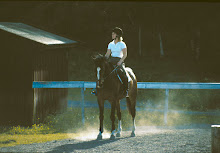
This is my daughters pony MacGyver, aka Charlie, aka Prince Charming.
He is such a sweet horse, and we really love him.
When you ride him he is always happy to cooperate, he works for light aids and tries to understand what you want.
If you really look hard for problems he is a bit ticklish when you brush his belly, and he can throw off the odd happy buck when out on trail, but that’s it.
Or at least, that’s what we thought – until now.
Prince Charming has been misbehaving.
We have had a very sweet girl at the same age as my daughter, C, that has been riding him twice a week for over a year.
C rode him well and everything was fine up to beginning of December when she wanted to stop riding him as Charlie had been misbehaving.
Charlie had been acting up when C was out on trail with two other riders from the stable.
C also said that Charlie had bucked with her in the arena a couple of times.
We understood nothing of this as he at the same period of time had been his normal angelic self with my daughter and me.
We were sad though as we liked C, but concluded that the level of what is scary can differ from person to person.
In December Charlie had time off due to a shoeing problem.
Around Christmas we started to ride him again.
And again, even after having time off, he was his normal cheery self and no misbehaving.
Until the new girl, M, was to ride him last week.
She tried him the week before without any problems, but comes Thursday and she was to have her first dressage lesson.
I was riding Fame at the same time, when our Prince Charming suddenly starts a rodeo show.
I could feel my chin fall down to my knees…what on earth was going on???!
M manages to stay on, and continues to ride.
Just to have another act of entertainment a few minutes after.
Still in a state of shock of my Dr Jekyll-Mr Hyde-pony, I ask M to change horse with me.
Our ill-mannered pony was opportunistic enough to try the same on me and gets an unpleasant surprise.
He tries once again, with the same result.
After that he is behaving himself again, and M sits up and rides the rest of the lesson without any problems.
He has apart from this incident never misbehaved with my daughter or me, or any adult persons riding him, so I rule out any health problems.
On the contrary, he is happy to work.
So I guess he was just looking for some extra entertainment.
Exit Prince Charming, hello Mr. Bad Guy.
Now to summarize this rather long story, I am coming back to the questions on top.
Is a horse’s character set in stone?
Is a nice horse always nice?
In the example above we have a horse where the setting around him is the same, and still he acts totally different depending on the rider.
If you in addition change environment, how you manage the horse and how you feed him, the horse might behave quite different.
So I would definitely say that a horse's character is not set in stone; it may differ quite a lot.
Here you have the difficulty in selling and buying horses.
Assessing the horse’s temperament is perhaps the most difficult task when you are out to buy.
You get a “feel”, and personally I always try to test by pushing the horse a bit, and see how he reacts.
But still it's a qualified guess, at its best.

From time to time I assist people in buying horses.
I love the match-making feeling, of trying to get a good horse-rider combination, and it makes me happy when things work out.
But I always try to have a discussion about the "adjusting period".
The horse is no car, it takes time to learn to know and ride a new horse.
In my opinion you need between 6 mths to a year to learn to learn to know your new partner.
Don't expect it to be perfect from the start, because it won't.
Or perhaps it's very good to begin with as the horse is still working on the previous, more experienced, owner's routines and riding, and then there is a performance drop after a while when the horse adjusts to the new, less experienced owner.
And so much is about management, and routines.
No turnout=bad horse.
Much feed, little exercise=bad horse
No rules=bad horse
I have been pondering a lot about my antelope problems before Christmas.
As it is difficult to get any answers from Fame I think I am concluding that less trail riding and no playing around when turned out (due to uneven, frozen ground) at least play a part in the equation.
Again, a change in managment (due to weather) that affects the behaviour of the horse.
Comments anyone?





 Posts
Posts


